The Veterinary Paradox: Why Does My Vet Recommend Hill’s Science Diet? 🩺🤔
Vets get 10-20 hours of nutrition training, often sponsored by Hill's and Purina. Here's why good vets recommend mediocre food and what you can do.
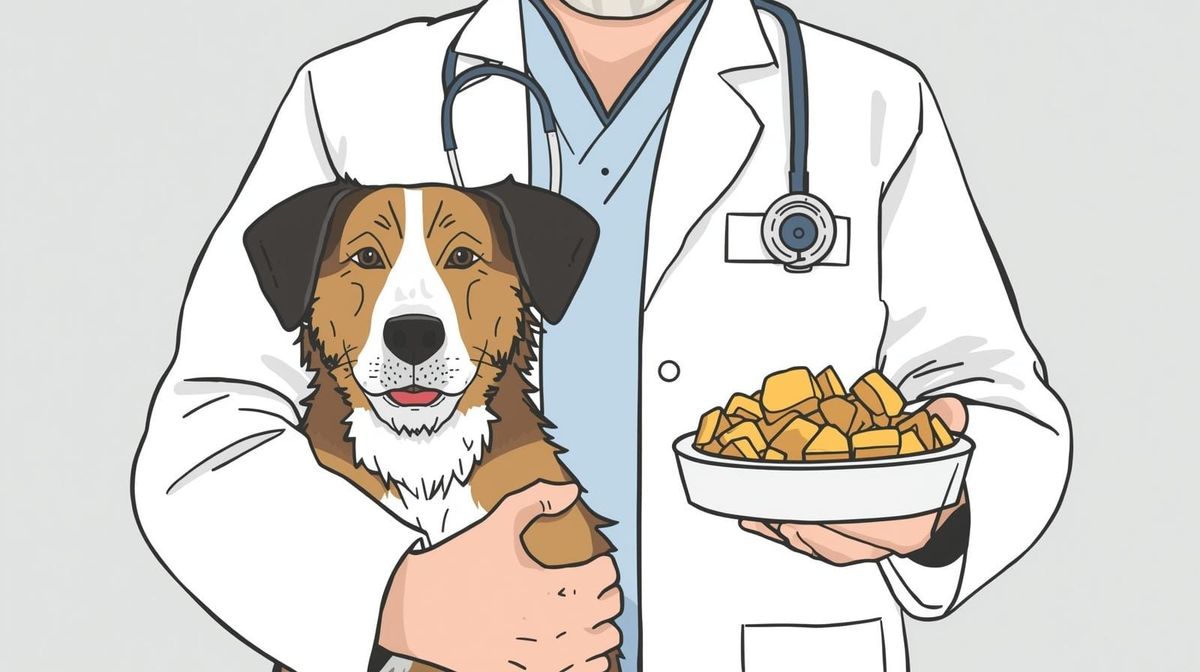
In our last post, we roasted the ingredient label of Hill's Science Diet. We looked at the corn gluten meal, the powdered cellulose — the sawdust filler hiding in a prescription-priced bag. The response was predictable: outrage, disbelief, and one question that kept coming back.
"If the ingredients are so mediocre, why does my vet have stacks of it in the lobby?"
It's a fair question. Your veterinarian is a medical professional. They went through years of rigorous training. They wear a white coat. They genuinely care about your dog. And they're recommending a food whose first five ingredients include cracked barley, whole grain wheat, corn gluten meal, and powdered cellulose — wood pulp — before anything resembling a named organ meat.
Are they lying? Are they bought off? Are they incompetent?
None of the above. Your vet isn't evil, and they aren't trying to make your dog sick. What's happening is more subtle — a decades-old system of educational sponsorship, clinical convenience, and legal liability that funnels well-meaning veterinarians toward three brands whether the ingredients justify it or not.
This is the Veterinary Paradox. Let's unpack it.
How Much Nutrition Training Do Veterinarians Actually Get?
Most veterinary students receive between 10 and 20 hours of formal nutrition education over their entire four-year program. That's less time than most of us spend researching which air fryer to buy. And when that limited training does happen, it is frequently sponsored, taught, or funded by Hill's, Royal Canin, and Purina.
The numbers are not a secret. A survey published in the Journal of the American Veterinary Medical Association found that the majority of veterinary schools in North America offer fewer than 20 contact hours of nutrition instruction across the entire curriculum. Twenty hours. In four years. For a topic that directly impacts the long-term health of every patient they'll ever see.
Within that narrow window, the Big Three — Hill's, Royal Canin, and Purina — have embedded themselves deeply. They provide the textbooks. They sponsor the guest lectures. They supply free food for students' own pets. They fund the continuing education seminars that practicing vets attend to maintain their licenses. The Tufts University Petfoodology team has openly discussed this dynamic, and investigations by the Veterinary Information Network have documented the depth of these financial entanglements.
By the time a veterinarian graduates, these brands are not just familiar. They're the default. They're what "science-backed nutrition" looks like, because they defined what "science-backed nutrition" looks like. The textbooks they funded are the textbooks vets learned from. The studies they sponsored are the studies vets cite. The reps who visited the campus are the reps who now stock the clinic shelves.
Why Do Prescription Diets Create a "Halo Effect"?
Hill's is genuinely effective at creating therapeutic prescription diets for specific medical conditions. If your dog has kidney disease, bladder stones, or a life-threatening metabolic disorder, Hill's has a formula that can chemically alter their urine, restrict phosphorus, or modulate protein intake to buy valuable time. Vets see these results and assume the over-the-counter maintenance diets must be equally exceptional.
This is the "Crisis vs. Health" confusion.
A prescription diet is a medical tool. It's formulated to do a specific job — acidify urine, restrict copper, limit protein — for a dog in a clinical crisis. It works. Vets see it work. They see dogs with bladder stones avoid surgery. They see dogs with kidney disease gain weeks or months of quality life. These are real outcomes.
The logical error is assuming that the maintenance diets — the bags sold to healthy puppies and adult dogs — are built with the same philosophy. They're not. A medicated tool is not the same as daily fuel. You wouldn't drink a prescription meal replacement shake every day for ten years just because it helped someone in a hospital. Your healthy dog needs real food, not a "maintenance" prescription built on corn gluten meal and sawdust.
We covered the full ingredient autopsy in our Purina Pro Plan roast and our Royal Canin takedown. Same playbook. Same problem. The prescription halo sells the maintenance bags.
Why Do Vets Recommend "Safe" Brands Instead of "Better" Brands?
Veterinarians operate under enormous professional stress. When a client asks "What should I feed my dog?", the vet needs an answer that is legally defensible, clinically familiar, and unlikely to generate a complaint. Hill's, with its massive legal team and decades of feeding trials, provides that safety net.
This is the "nobody ever got fired for buying IBM" strategy of the pet world.
If a vet recommends a boutique, grain-free, or raw brand and the dog develops a health problem — even one completely unrelated to the food — the vet is exposed. The owner can blame the recommendation. The brand doesn't have a legal team that will defend the vet. The vet's liability insurance may not cover "alternative" nutritional advice.
If the vet recommends Hill's and the dog develops the same problem, the vet can point to the feeding trials, the AAFCO statement, the "science" on the bag. They're protected. The recommendation is defensible. The system is built to reward safe choices, not optimal ones.
This is not a conspiracy. It's institutional risk management. And it produces recommendations that prioritize legal safety over ingredient quality. We documented the same dynamic in our investigation of how best dog food lists are bought and paid for. The brands with the biggest legal and marketing budgets win. The brands with the best ingredients get called "boutique" and dismissed.
Who Funds the "Science" in Veterinary Nutrition?
Hill's, Royal Canin, and Purina collectively fund a significant portion of the published clinical research in companion animal nutrition. They get to define what "science-led" means because they're paying for the studies, sponsoring the journals, and running the feeding trials.
It's easy to win the game when you're the one paying the referees and building the stadium.
The research these brands fund is not fraudulent. It's methodologically sound. Feeding trials are real. AAFCO standards are met. But the questions being asked are shaped by the entities paying for the answers. The research focuses on meeting minimum nutritional requirements to prevent deficiency — not on achieving optimal nutrition to promote longevity.
There is no Hill's-funded study comparing the long-term health outcomes of dogs fed corn-based kibble versus dogs fed fresh, whole-food diets. That study would not serve the business model. The research that exists is designed to validate the products that exist. This is not unique to pet food — it's a well-documented phenomenon across pharmaceutical, food, and supplement research. But it matters here, because your vet is making recommendations based on a body of evidence that was shaped by the companies being recommended.
How to Talk to Your Vet About Dog Food (Without Being a Jerk)
Your vet is your partner in medical crises. You don't need to convert them to raw feeding. You need to advocate for your dog's daily nutrition while respecting their clinical expertise. Here's how to navigate the conversation.
Ask "Why?"
Instead of saying "This food is trash," ask: "What specific ingredient in this bag is benefiting my dog's current health condition?" If the vet can't point to a specific ingredient and explain its mechanism, the recommendation is habit, not medicine.
Request a Comparison.
Pull up a Safe List brand like Open Farm or Sundays for Dogs. Ask: "Does this meet the same AAFCO standards as Hill's?" The answer is always yes. AAFCO certification is a floor, not a ceiling. Meeting it doesn't make Hill's special.
Stand Your Ground on Transparency.
"I prefer to feed my dog ingredients that are legally fit for human consumption." Most vets can't argue with that. There is no medical reason to feed feed-grade ingredients to a healthy dog when human-grade alternatives exist. This single sentence reframes the conversation from "alternative vs. conventional" to "transparent vs. opaque." It's hard to argue against transparency.
Know When to Listen.
If your dog has a diagnosed medical condition — kidney disease, liver shunt, severe IBD — and your vet recommends a specific prescription diet, listen. Those formulas do things regular food can't. The Hill's hate is for the maintenance bags, not the therapeutic ones. A medicated tool for a sick dog is different from daily fuel for a healthy one. Don't let the roast blind you to the nuance.
Frequently Asked Questions About Veterinary Food Recommendations
Q: Is my vet getting a kickback for selling Hill's?
Not directly in most cases. Veterinarians do not receive commissions from Hill's in the way pharmaceutical reps compensate human doctors. However, the clinics profit from the retail markup on the food they sell, and the educational system that trained your vet was funded by these brands. The influence is structural, not transactional.
Q: Should I switch vets if they push Hill's?
Not necessarily. A vet who pushes Hill's but listens to your concerns, respects your questions, and engages with the ingredient conversation is worth keeping. A vet who dismisses your questions with "Hill's is backed by science" and refuses to engage further might not be the right partner for you. The relationship matters more than the recommendation.
Q: Are prescription diets ever necessary?
Yes. For specific medical conditions — struvite crystals, advanced kidney disease, copper storage disease — prescription diets can be life-saving therapeutic tools. The problem is not prescription diets. The problem is applying the prescription halo to the over-the-counter maintenance formulas and assuming they're equally exceptional.
Q: Does Hill's meet AAFCO standards?
Yes. Hill's meets or exceeds AAFCO nutrient profiles through a combination of ingredients and synthetic vitamin supplementation. Meeting AAFCO minimums is not the same as being optimal. Many foods that meet AAFCO standards are built on corn, by-products, and fillers. The standard is a floor, not a ceiling.
The Bottom Line
Your veterinarian is your partner in medical crises. But you are the CEO of your dog's daily nutrition.
The system that trained your vet was funded by the brands they recommend. The textbooks, the lectures, the free food, the clinical studies — all of it was supplied by companies that profit when you buy their corn-based kibble. Your vet isn't corrupt. They're operating inside a system that was built before they arrived and will be there long after they retire.
The Critic's Code exists to give you a framework outside that system. The Safe List exists to show you what's possible when ingredients matter more than marketing. And the 5-Second Label Lie Detector exists to help you see what's actually in the bag — regardless of who recommended it.
Your vet heals your dog when they're sick. You fuel them every single day. Those are different jobs. Treat them that way.
Has your vet recommended Hill's, Royal Canin, or Purina? Did they explain why — or just point to the bag? Tell me your experience in the comments. Let's see how many of us have had the exact same conversation in the exam room.