Senior Dog Brain Health: B12, Folate, and the Organ Meats That Slow Cognitive Decline

Your senior dog still wags their tail when you walk through the door. They still follow you to the kitchen. But something's different. They stare at walls. They get lost in corners. They don't respond to their name the way they used to. They pace at night. They seem distant, confused, somewhere between awake and lost.
The vet calls it canine cognitive dysfunction — dog dementia — and tells you it's just old age. There's medication that might help. It's expensive. The results are modest.
Maybe it is old age. But maybe it's something simpler. Maybe your dog's aging brain is starving for two specific nutrients that are almost entirely absent from most commercial dog food: vitamin B12 and folate.
These aren't obscure compounds. They're essential for every nerve cell in your dog's body. They're abundant in one place — organ meat — and almost nowhere else in the modern canine diet. The research is clear: B12 deficiency causes neurological symptoms that look exactly like dementia in dogs. The difference is, B12 deficiency is fixable.
What Causes Cognitive Decline in Senior Dogs?
Cognitive decline in aging dogs has multiple contributors: oxidative stress, reduced cerebral blood flow, neurotransmitter depletion, beta-amyloid plaque accumulation, and — critically — micronutrient deficiencies. B12 and folate deficiency directly impair nerve function, myelin maintenance, and neurotransmitter production.
B12 is required for the synthesis and maintenance of myelin — the fatty insulating sheath that surrounds nerve fibers and allows rapid signal transmission. Without myelin, nerve signals slow down. Processing speed drops. The brain still works — it just works slower. A study in the Journal of Veterinary Internal Medicine documented that dogs with cognitive dysfunction had significantly lower serum B12 levels than age-matched controls.
Folate is required for DNA synthesis and repair in every cell, including neurons. It's also a cofactor in the production of serotonin, dopamine, and norepinephrine — neurotransmitters that regulate mood, sleep, and cognition. When folate is low, neurotransmitter production drops. The brain can't maintain its signaling infrastructure.
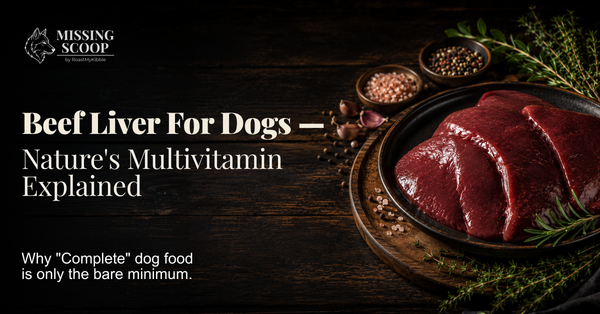
Both nutrients are abundant in beef liver. Both are nearly absent in muscle meat, grains, and most commercial kibble unless added synthetically. A senior dog eating a standard diet may be functionally B12-deficient for years, and the symptoms — confusion, disorientation, altered sleep patterns — will be written off as "getting old."
Which Nutrients Support the Aging Brain?
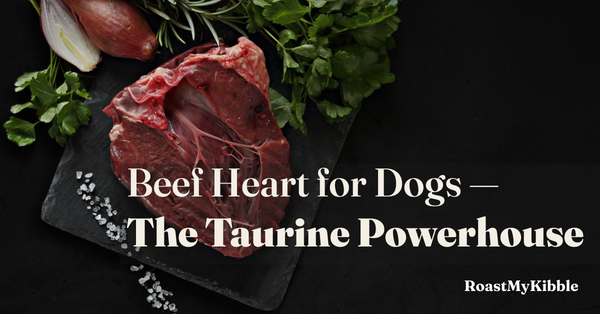
Beef liver is the richest natural source of B12 and folate available. Beef heart provides CoQ10, a mitochondrial antioxidant that declines with age and is critical for cellular energy production in the brain.
| Nutrient | Primary Source | Role in Brain Health |
|---|---|---|
| Vitamin B12 | Beef liver | Myelin synthesis and maintenance, nerve signal speed |
| Folate | Beef liver | DNA repair in neurons, neurotransmitter production |
| CoQ10 | Beef heart | Mitochondrial energy production, antioxidant protection |
| Iron | Beef liver, heart | Oxygen delivery to brain tissue |
CoQ10 deserves special attention. It's concentrated in the mitochondria — the energy power plants inside every cell. Brain cells have enormous energy demands. CoQ10 is essential for converting nutrients into usable cellular energy. It also functions as a fat-soluble antioxidant within cell membranes. Levels of CoQ10 decline naturally with age — in dogs and in humans. Dietary CoQ10, primarily from heart muscle, partially offsets that decline.
We covered liver's full profile in the beef liver deep dive and heart's CoQ10 and cardiac benefits in the beef heart deep dive. For senior dogs, the combination of both organs — liver for B12 and folate, heart for CoQ10 — is a nutritional safety net that costs pennies a day.
How Long Before I See Changes?
B12 and folate are water-soluble vitamins. Improvements in energy, alertness, and responsiveness can begin within days to weeks of consistent supplementation. Structural neurological improvements — myelin repair, neurotransmitter normalization — may take 4–12 weeks. If symptoms are due to irreversible neurodegeneration, results will be limited, but nutritional support still improves quality of life.
The key is consistency. One dose of liver won't reverse months of deficiency. Daily, small amounts over weeks will. The brain is slow to heal and quick to suffer. Patience and persistence are the play.
Frequently Asked Questions About Senior Dog Brain Health
Q: Is canine cognitive dysfunction reversible?
In some cases, yes — when the underlying cause is a reversible nutritional deficiency. In cases of true neurodegenerative disease with beta-amyloid accumulation and neuronal loss, the damage is permanent. But nutritional support can slow progression and improve remaining function. There is no downside to optimizing nutrient status in a senior dog.
Q: Can I just give my dog a B12 pill?
You can, but food-source B12 from liver comes packaged with the protein carriers and cofactors that support absorption and utilization. Liver also provides folate, iron, copper, and CoQ10 — all relevant to brain function. A single pill can't replicate the synergistic effect of whole food.
Q: How do I know if my senior dog is B12 deficient?
Serum B12 can be measured by your veterinarian. However, functional deficiency can exist even when blood levels are within the normal reference range, particularly in older dogs. Dietary history — what's actually in the bowl — is often the most useful diagnostic tool.
What to Do This Week
Add liver. If your senior dog has never had it, start with a thumbnail-sized piece per day. Watch their eyes over the next two weeks. Look for recognition. For that moment when you say their name and they snap back — not lost, not distant, just there. You might see the dog you remember. They've been in there the whole time. They were just missing the nutrients their brain needed to show you.
Missing Scoop delivers liver and heart in every scoop — freeze-dried, B12 and CoQ10 intact, ready in seconds.
How old is your dog? Have you noticed any cognitive changes? What are you feeding? Let's talk about it in the comments.