The 37 Essential Nutrients for Dogs: Whole-Food Sources, Availability, and Safety

You know the gaps. AAFCO sets minimums, but minimums aren't optimal. Homemade diets — even the best-intentioned ones — miss key nutrients. We covered the why in our last post: the muscle meat trap, the land-vs-sea split, the cooking degradation problem.
Now the practical question: what do I actually feed to fill those gaps?
This is the ingredient-by-ingredient guide. Not a chemistry lecture. A shopping list. For every essential nutrient your dog needs, here's what real food provides it, whether it's easy to find at a grocery store or requires a trip to a specialty market, and how to use it safely.
⚡ TLDR
This is the ingredient-by-ingredient guide to the 37 essential nutrients your dog needs. For every vitamin and mineral, you'll find the best whole-food source, how easy it is to get at a grocery store, and how to use it safely. Includes a deep dive on how much liver is too much — and why the fear of liver toxicity has been wildly overstated.
The Complete Nutrient Source Table
Legend: 🟢 Easy (standard grocery store) | 🟡 Moderate (specialty market or online) | 🔴 Hard (requires hunting/ordering) | ⚠️ Toxic at high doses
| Nutrient | Why Your Dog Needs It | Common Source (Easy) | Harder-to-Find Source | Notes |
|---|---|---|---|---|
| Protein (Amino Acids) | Muscle maintenance, enzyme production, immune function | Chicken, beef, turkey, eggs, fish | — | Animal sources are complete. Plant sources are not. |
| Fat | Energy, cell membrane integrity, vitamin absorption | Chicken fat, beef fat, salmon oil | — | Named sources only. Avoid "animal fat" (anonymous). |
| Omega-3 (EPA/DHA) | Brain function, inflammation regulation, skin health | Fatty fish (salmon, sardines), fish oil | Algae oil, phytoplankton | 🟢 Canned sardines in water are cheap and easy. |
| Vitamin A | Vision, skin barrier, immune function | Beef liver, chicken liver, egg yolks | — | ⚠️ Toxicity possible at chronic high doses. Full liver guide here. |
| Vitamin D | Calcium absorption, bone health, immune function | Fatty fish, egg yolks, beef liver | Cod liver oil (⚠️ high vitamin A + D) | Sunlight not sufficient for dogs. Diet required. |
| Vitamin E | Antioxidant, cell membrane protection | Sunflower seeds, spinach, almonds | Wheat germ oil, hemp seeds | 🔴 Very easy to miss in homemade diets. A common gap. |
| Vitamin K | Blood clotting, bone metabolism | Beef liver, leafy greens | Fermented foods (natto) | 🟢 Liver provides natural K2. Avoid synthetic menadione. |
| B Vitamins (B1, B2, B3, B5, B6, B7, B9, B12) | Energy metabolism, nerve function, red blood cell production | Beef liver, beef heart, eggs, fish | Nutritional yeast (B-complex) | 🟢 Liver covers most B vitamins in one ingredient. |
| Calcium | Bone structure, nerve signaling, muscle contraction | Eggshell powder, bone meal, plain yogurt | Raw meaty bones | 🔴 Most common deficiency in boneless homemade diets. |
| Phosphorus | Bone structure, energy metabolism | Meat, organs, bone | — | 🟢 Rarely deficient. Balance with calcium is key. |
| Magnesium | Enzyme function, muscle relaxation | Pumpkin seeds, spinach, fish | — | 🟡 Often overlooked. Can contribute to anxiety if low. |
| Zinc | Immune function, skin health, wound healing | Beef liver, beef heart | Oysters (canned, in water) | 🟡 Oysters are the richest source but need ordering. |
| Manganese | Bone formation, enzyme function | Mussels (green-lipped or blue), pumpkin seeds | — | 🔴 Mussels are the best source but may require specialty store. |
| Iodine | Thyroid hormone production | Kelp powder, fish, eggs | — | 🟡 Kelp powder is shelf-stable and easy to add. |
| Copper | Collagen cross-linking, iron metabolism, coat color | Beef liver | — | 🟢 Liver covers it. Rarely deficient if liver is included. |
| Iron | Oxygen transport, energy production | Beef liver, beef heart, beef kidney | — | 🟢 Organ meats cover it. |
| Selenium | Antioxidant function, thyroid health | Beef kidney, fish, eggs | Brazil nuts (⚠️ extremely high — one nut covers days) | 🟡 Selenium from kidney is safer than Brazil nuts. |
| Potassium | Nerve signaling, muscle contraction | Salmon, beef, sweet potato | — | 🟢 Common in many whole foods. |
| Choline | Brain function, liver health | Eggs, beef liver | — | 🟢 Eggs are an excellent source. |
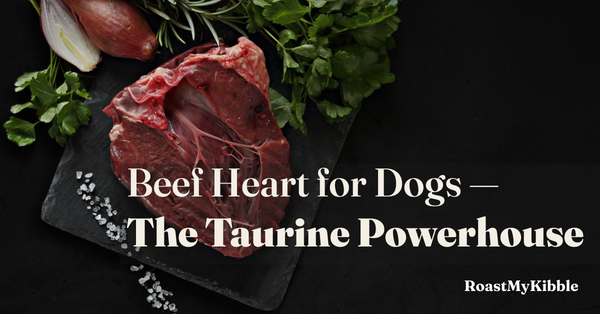
| Taurine | Cardiac function, vision, bile acid production | Beef heart, dark poultry meat | — | 🟡 Heat-sensitive. Raw or freeze-dried preserves it. |
How Much Liver Is Too Much?
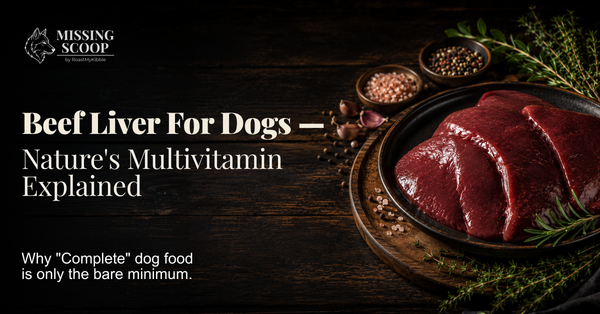
Liver should make up approximately 5% of your dog's total diet by weight. For a 50-pound dog eating about 1 pound of food daily, that's roughly 0.8 ounces (22 grams) of liver per day. At this amount, vitamin A intake is well below the toxic threshold. Toxicity requires chronic, massive overfeeding — roughly 2,500–5,000 IU of vitamin A per pound of body weight per day over weeks to months.
Let's do the math so you can see the safety margin.
A 50-pound dog needs to consume roughly 125,000–250,000 IU of vitamin A per day for weeks to months to reach the toxic threshold. One ounce of beef liver contains approximately 4,800 IU. At the recommended 5% liver in the diet — 0.8 ounces per day — that's 3,840 IU of vitamin A. That's 30–65 times below the toxic threshold.
You would need to feed your 50-pound dog over half a pound of liver every single day for weeks to approach toxicity. That's not liver as a supplement. That's liver as a main course. Nobody is doing that accidentally.
The symptoms of vitamin A toxicity — joint stiffness, bone spurs, lethargy, digestive upset — are from chronic, long-term overfeeding. They are not from a few ounces of liver a few times a week. The fear of liver toxicity has been wildly overstated in online dog nutrition spaces, and it's scared people away from one of the most nutrient-dense foods on the planet.
We covered this in detail in the beef liver deep dive. The short version: feed liver at 5% of the diet, and you'll never come close to the danger zone. For a practical system to make this easy, see our complete rotation guide.
The "Inconvenience Gap" Explained
Some nutrients are easy to source. Some require a bit of effort. This is the "inconvenience gap" — the reason certain nutrients are routinely missing from homemade diets even when the owner knows they exist.
🟢 Easy to Get (Standard Grocery Store):
Protein, fat, calcium (eggshells), vitamin A (liver), copper (liver), iron (organs), B vitamins (liver, eggs), potassium (meat, sweet potato).
🟡 Takes a Little Effort (Specialty Market or Online):
Omega-3s (canned sardines are easy, but some owners don't think to add them), vitamin D (fatty fish or cod liver oil), magnesium (pumpkin seeds), zinc (oysters or extra liver), iodine (kelp powder), vitamin E (sunflower seeds or wheat germ oil).
🔴 Genuinely Hard to Source (Requires Ordering):
Manganese (mussels are the best source, and not every grocery store carries them). This is the single most common missing mineral in homemade diets because it's not found in meaningful amounts in standard grocery store meats and vegetables.
How to Build a Balanced Bowl
A balanced diet doesn't require a perfect meal every time. It requires a pattern over time. Include these categories regularly, and the gaps close naturally:
- Muscle meat for protein and amino acids (80% of the diet)
- Liver at 5% for vitamin A, copper, B vitamins
- Other organs (heart, kidney) for taurine, selenium, and additional B vitamins
- A calcium source (eggshell powder, bone meal, or raw bones)
- Fatty fish once or twice a week for vitamin D and omega-3s
- A small amount of plant matter (leafy greens, pumpkin seeds, kelp) for magnesium, vitamin E, manganese, and iodine
- Variety over time — different proteins, different organs, different vegetables
No single recipe covers everything. That's the truth. But a pattern of variety — what you feed over a month, not a single meal — is how wild canids achieve nutritional balance. It's how your dog will too. For a complete 4-week plan that does this for you, read our complete rotation guide.
And if sourcing and rotating organs sounds like more work than you want to take on, Missing Scoop delivers grass-fed beef liver, heart, and kidney in a single scoop — freeze-dried, nutrient-intact, zero prep. For the rest, add some fatty fish, a sprinkle of kelp, and a handful of greens over the course of a week. That's the difference between meeting minimums and achieving optimal health.
What's the one nutrient you're pretty sure your dog's diet is missing? Drop it in the comments and we'll help you find a whole-food source.