Joint pain in Dogs? Look at what nutrients your dog's missing.
our dog is too young for arthritis. The vet said so. But they're stiff in the morning. They limp after a long walk. They don't bounce back from exercise the way they used to. You've tried glucosamine. You've tried chondroitin. You've bought the $60 joint chews that smell like a vitamin factory. The stiffness is still there.
Here's what the supplement aisle won't tell you: your dog might not be deficient in glucosamine. They might be deficient in copper.
Copper is the forgotten mineral in canine nutrition. Nobody talks about it. It doesn't have a glossy marketing campaign. It's not in the name of a single joint supplement at the pet store. But without it, your dog can't build the connective tissue that holds their joints together. Collagen fails. Elastin fails. Ligaments weaken. And your young, active dog starts moving like a senior.
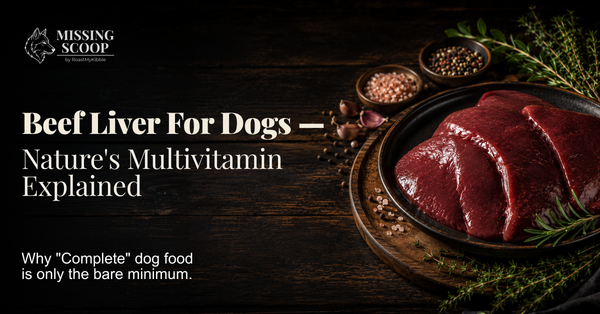
The fix isn't another joint chew. It's beef liver. And if that sounds too simple, wait until you see the numbers.
Why Does Copper Matter for Joint Health?
Copper is a cofactor for lysyl oxidase, the enzyme that cross-links collagen and elastin fibers. Without adequate copper, connective tissue becomes weak and brittle. Joints lose their elasticity. Tendons and ligaments become prone to injury.
Think of collagen and elastin as the scaffolding that holds your dog's joints together. Copper is the rivet that locks the scaffolding in place. Without rivets, the structure holds for a while — then it starts to wobble. Then it fails.
This is why copper deficiency shows up as joint stiffness, particularly in young, growing dogs whose connective tissue is developing rapidly. It's why some active dogs seem to age overnight. It's why the glucosamine isn't working — because glucosamine supports cartilage repair, but copper supports the structural integrity of the entire joint. Cartilage sits on a foundation of collagen. If the foundation is crumbling, repairing the surface won't save the building.
Research published in the Journal of the American Veterinary Medical Association has documented that copper deficiency in growing dogs leads to weakened connective tissue, spontaneous fractures, and joint abnormalities. It's not a theoretical concern. It's a documented nutritional disease.
Copper is also required for:
- Iron metabolism — copper-dependent enzymes mobilize iron for red blood cell production
- Melanin production — coat color depends on copper
- Antioxidant function — copper is a component of superoxide dismutase, a key cellular antioxidant that protects joint tissues from oxidative damage
Your dog's joints need copper. Most dog food doesn't have enough — or has it in a form your dog can't efficiently absorb.
Where Does Copper Come From in a Dog's Diet?
Beef liver is the richest natural dietary source of copper available to dog owners. A 100-gram serving of beef liver contains approximately 9.8 mg of copper — over 200 times the copper content of chicken breast.
| Food | Copper (per 100g) |
|---|---|
| Beef Liver | 9.8 mg |
| Beef Kidney | 0.4 mg |
| Beef Heart | 0.4 mg |
| Chicken Breast | 0.04 mg |
| Brown Rice | 0.1 mg |
The numbers are not subtle. Liver contains orders of magnitude more copper than any muscle meat or grain. If you're feeding a standard kibble built on chicken, rice, and corn, your dog is getting almost no dietary copper beyond whatever synthetic copper sulfate the manufacturer sprayed on at the end.
Synthetic copper sulfate is poorly absorbed. According to AAFCO nutrient profiles, the minimum copper requirement for adult dogs is 7.3 mg per kilogram of diet — but those numbers assume optimal absorption, which synthetic sources don't provide. Liver copper is naturally chelated to amino acids and absorbed efficiently. The difference in bioavailability is well-documented in animal nutrition research.
We covered liver's full nutritional dominance in our beef liver deep dive. Copper is just one line on a very long list.
How Much Liver Should I Feed for Joint Support?
Liver should make up approximately 5% of your dog's total diet by weight. For a 50-pound dog eating about 1 pound of food daily, that's roughly 0.8 ounces (22 grams) of liver per day. At this amount, the copper contribution is significant and safe.
A 50-pound dog receiving 0.8 ounces of beef liver daily gets approximately 2.2 mg of highly bioavailable copper — enough to support connective tissue maintenance without approaching toxic thresholds. Copper toxicity in dogs requires chronic intake far above this level, typically from industrial contamination or improper supplementation, not from food.
Do not overfeed liver. Copper toxicity is real at chronic high doses, and liver is potent. But at 5% of the diet, it's safe, effective, and provides a meaningful copper boost that supports connective tissue health across the entire body — joints, skin, coat, blood vessels.
Frequently Asked Questions About Copper and Joint Health
Q: Can copper deficiency really cause joint pain in a young dog?
Yes. Copper-dependent collagen cross-linking is essential for joint integrity. Deficiency weakens connective tissue, making joints prone to stiffness and injury — even in young, active dogs. This is documented in veterinary literature going back decades.
Q: How long does it take for liver to improve joint symptoms?
Connective tissue remodeling is slow. Collagen turnover takes weeks to months. Most owners report noticeable improvement in stiffness and mobility within 4–8 weeks of consistent liver feeding. Full structural benefits may take 12 weeks or more.
Q: Is glucosamine useless?
Not useless. Glucosamine supports cartilage repair, which is important. But cartilage sits on a foundation of collagen, and collagen needs copper. Without adequate copper, you're repairing the surface while the foundation crumbles. Both matter. Most joint supplements address one and ignore the other.
Q: Can my vet test for copper deficiency?
Copper status is difficult to assess through standard bloodwork. Serum copper doesn't reliably reflect tissue stores. Liver biopsy is the gold standard but is invasive and rarely performed. Dietary assessment — what's actually in the bowl — is often the most practical diagnostic tool.
What to Do This Week
Add liver to your dog's bowl. Start small — half the recommended amount for the first week. Watch their mobility over the next month. You might find that the joint supplement you've been buying for $60 a month was treating a symptom while the real deficiency sat in the grocery store for $3 a pound.
And if handling raw liver sounds like a task you'd rather skip, Missing Scoop delivers grass-fed beef liver in every scoop — freeze-dried, copper intact, zero prep.
Has your young dog struggled with joint stiffness? What did you try — and did anyone mention copper? Drop your experience in the comments.