How to Boost Your Dog's Immune System Naturally (Without Synthetic Vitamins)

The immune system is not a switch. You can't flip it on with a pill. It's a complex, distributed network of physical barriers, specialized cells, signaling molecules, and memory cells that requires a constant supply of specific micronutrients to function. When those nutrients are missing, the system doesn't crash — it just gets slow. Infections linger. Wounds heal poorly. Your dog picks up every bug at the dog park, and you can't figure out why.
The pet food industry's solution is a synthetic vitamin premix sprayed onto kibble after extrusion — lab-made vitamin A palmitate, zinc oxide, sodium selenite. These meet AAFCO minimums on paper. They prevent frank deficiency diseases. But they don't perform like whole food. Your dog's immune system knows the difference between a vitamin that came from liver and one that came from a chemical vat.
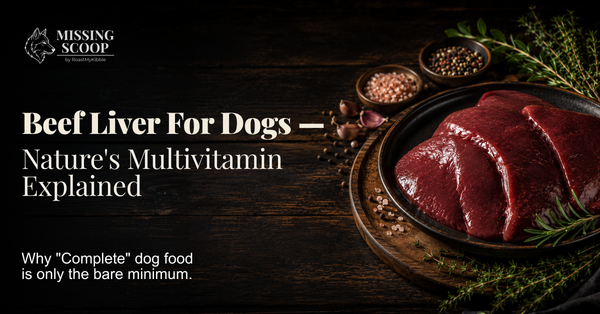
The solution isn't a stronger supplement. It's beef liver and kidney — two of the most immune-supportive foods in existence, delivering the exact micronutrients your dog's immune cells need in the form they evolved to recognize and absorb.
Which Nutrients Does the Immune System Actually Need?
The canine immune system depends on vitamin A for barrier integrity, zinc for T-cell development and function, selenium for antioxidant protection, and B vitamins for cellular energy production. Beef liver and kidney contain all four in highly bioavailable forms, packaged with the cofactors that make them work.
- Vitamin A (beef liver): Maintains mucosal barriers — the gut lining, the respiratory tract, the skin. These epithelial surfaces are your dog's first line of defense. Vitamin A regulates the production of mucins and antimicrobial peptides that form a physical and chemical barrier against pathogens. Without adequate vitamin A, these barriers thin and become permeable. Pathogens walk through the front door.
- Zinc (beef liver, kidney): Required for T-cell development, differentiation, and function. The thymus gland — where T-cells mature — is exquisitely sensitive to zinc status. Zinc deficiency causes thymic atrophy: the gland shrinks, T-cell output drops, and cell-mediated immunity declines. Research published in the Journal of Nutrition has documented that even marginal zinc deficiency impairs immune function in dogs.
- Selenium (beef kidney): A component of the glutathione peroxidase enzyme system — one of the body's master antioxidant networks. During an immune response, white blood cells generate reactive oxygen species to kill pathogens. Selenium-dependent enzymes protect those same white blood cells from their own oxidative burst. Without selenium, immune cells die in the process of defending the body.
- B vitamins (beef liver, kidney): B6, B12, and folate are consumed rapidly during an active immune response. They're required for cell division, antibody production, and energy metabolism in immune cells. A mounting immune response demands B vitamins. If the diet doesn't supply them, the response is blunted.
A synthetic multivitamin can list these nutrients on a label. It cannot replicate the enzymes, cofactors, fatty acids, and absorption pathways that whole food provides. We documented this gap extensively in our freeze-dried vs. raw vs. cooked nutrition comparison. Whole food wins every measurable outcome.
Why Do Dogs on the Same Kibble Get Sick at Different Rates?
Two dogs can eat the same food and have different immune outcomes because genetics, stress, age, and gut health all influence nutrient absorption and utilization. A dog with marginal zinc or vitamin A status may show no symptoms until a stressor — illness, injury, boarding, travel — pushes their system past its functional reserve.
The kibble meets AAFCO minimums. It's legally "complete and balanced." But "minimum to prevent deficiency disease" is not the same as "optimal for immune resilience." Your dog's immune system doesn't read AAFCO guidelines. It reads nutrient availability. When availability drops, resilience drops with it. The dog that gets sick after every boarding stay or every trip to the dog park may not have a weak constitution. They may have a diet that's barely meeting minimums and leaving no reserve for stress.
How to Feed for Immune Support
Add liver and kidney to your dog's diet at recommended amounts: roughly 5% liver and 2–3% kidney of the total diet by weight. For a 50-pound dog eating about 1 pound of food daily, that's about 0.8 ounces of liver and 0.4 ounces of kidney per day.
Start slow. Both organs are rich. Introduce one at a time so you know what your dog tolerates. Vitamin A, zinc, and selenium are stored in tissues and incorporated into immune cells over a period of weeks. The nutrients you feed today are building the immune response your dog mounts next month. Consistency matters.
Frequently Asked Questions About Immune Health
Q: Can I just give my dog a multivitamin?
You can, but absorption will be lower, and you'll miss the cofactors that make whole-food nutrients effective. Beef liver delivers vitamin A alongside the fats and enzymes your dog's body needs to use it. A pill delivers the vitamin in isolation. The difference in bioavailability is significant.
Q: Will these organs help with seasonal allergies?
Allergies are an immune dysregulation issue — the system overreacting to harmless environmental proteins. Zinc and vitamin A both modulate immune responses and support barrier integrity. While organs aren't a cure for allergies, a nutrient-replete immune system is less likely to overreact to harmless stimuli. Several veterinary dermatologists recommend assessing nutritional status as part of an allergy workup.
Q: How quickly will I see results?
Cellular immune improvements — enzyme production, T-cell populations, barrier integrity — begin within 2–4 weeks of consistent feeding. Visible outcomes — fewer infections, better wound healing, improved overall resilience — may take 4–8 weeks to become apparent.
Q: Is selenium toxicity a concern with kidney?
Selenium toxicity requires chronic, extreme intake — far beyond what kidney provides at recommended amounts. Beef kidney at 2–3% of the diet supplies selenium well within safe limits while providing meaningful immune support.
What to Do This Week
Add liver. If you're already feeding liver, add kidney. If you're feeding neither, start with liver — it's the single most nutrient-dense food you can put in your dog's bowl. Your dog's immune system is running on whatever you feed it. Make it count.
Missing Scoop delivers both liver and kidney in every scoop — freeze-dried, nutrients intact, zero synthetic anything.
Does your dog get sick often? What's in their bowl right now? Drop it in the comments. Let's see if the immune system is getting what it actually needs.